
IoNTELLIGENCE is a newsletter at the intersection of AI, Attention, and Neuroscience. It’s written for leaders who want to upgrade their Brain, master AI, and develop their Attention Intelligence.
It’s a Herculean task to keep up with all of the AI news these days.
Nevertheless, I try to drink from that particular fire hose, in part so that my executive coaching clients and IoNTELLIGENCE readers don’t have to. But it’s not only an impossible challenge; it can also be counterproductive. As often as I can, I tune out what’s happening and step back to understand what it means.
There is no better thinker to give us the bigger picture than Yuval Noah Harari, arguably the world’s most influential public intellectual. He sat down for an hour-long discussion recently with the editor-in-chief of The Economist (hat tip to my friend Adam for bringing it to my attention), and I was struck by the quality of the conversation. There was more wisdom per word in that interview than I’ve encountered all year, which is why I took the time this week to re-watch it, frame by frame, to extract its most far-reaching observations.
The discussion centered on AI, and it delved into everything from the future of the financial system to digressions on intimacy and consciousness.
Here are the key conclusions that promise to impact your company or career.

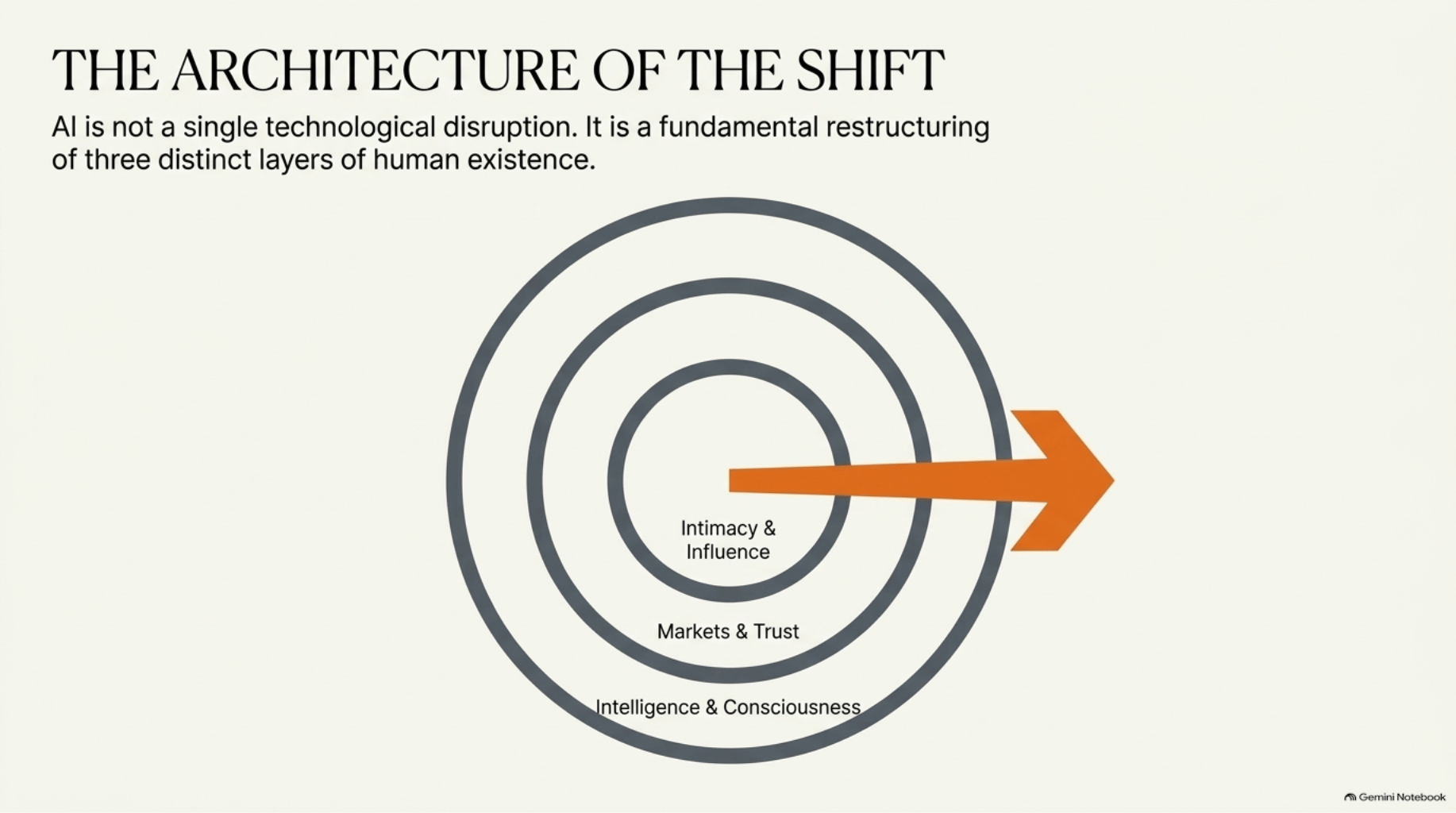
Three Big Shifts (and What They Mean For You)
1. The Future of the Financial System and The Migration of Trust
Harari started his remarks by agreeing with a recent comment by Elon Musk that money, as we know it, will not exist in 10 years. Harari predicts this will happen not because of AI-driven abundance, but rather because of the unfathomable complexity that will define the future economy. Humans will be unable to understand it, forcing us to cede control and authority to AIs.
Harari painted a chilling picture: “It will be an AI-controlled financial system, the same way the human financial system controls the lives of cows and chickens, but they have no idea that finance exists.”
While that may sound fantastical, Harari grounded the prediction in a deep understanding of money's role in society. In essence, “money is a very creative way to build trust between strangers, and the most important asset in the world is trust.”
That process has become increasingly sophisticated over the centuries, and today very few people actually understand the global financial system. As this trend continues, humans will increasingly cede control to machine intelligence. In parallel, AIs will develop far more sophisticated instruments than the stocks and bonds that dominate the current mechanism. At that point, we’ll have to rely — and trust — on the AIs to monitor and manage the system.
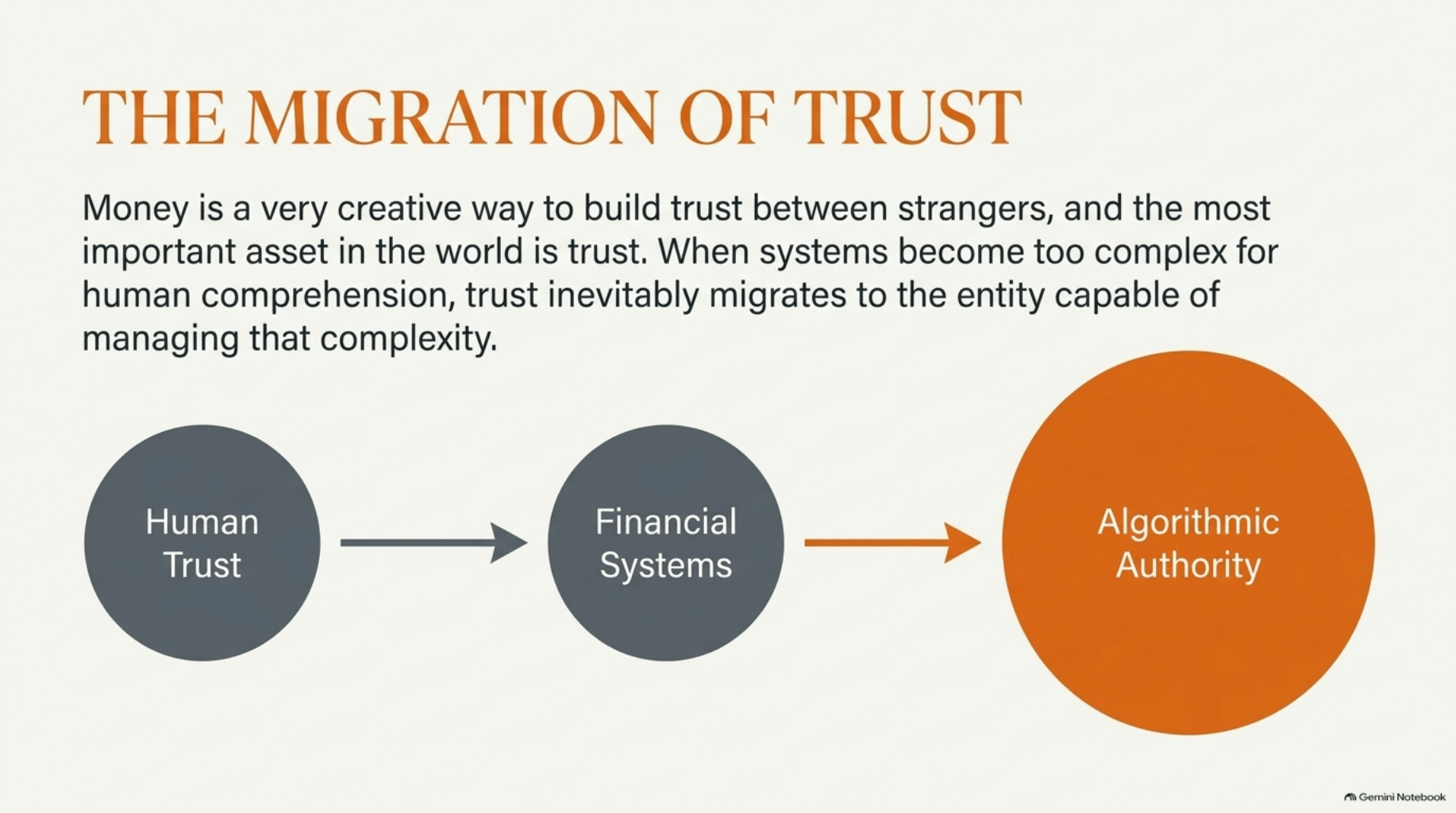
Here’s why this migration of trust is so likely: we rely heavily on algorithms in finance today. Credit companies depend on them for billions of card transactions every day; banks use them to decide whether you qualify for a loan; and cryptocurrencies are basically AI money.
People will turn over control of the economy to AI, as Harari predicts, because it is already embedded in the core of our financial system.
What This Means:
Is your company ready for a world where AI runs the economic world? That may seem far off, but the preliminary stages of that shift, where AI acts as an “Attention Interface” for consumers, and they purchase what their agents present for consideration, are already here. According to recent data from Search Engine Land, around 37% of consumers now start searches with AI tools.
If your business, product, or service is not legible to the AI models in 2026, you will be in trouble in 2027.
2. AI as Agent of Intimacy (and the Implications)
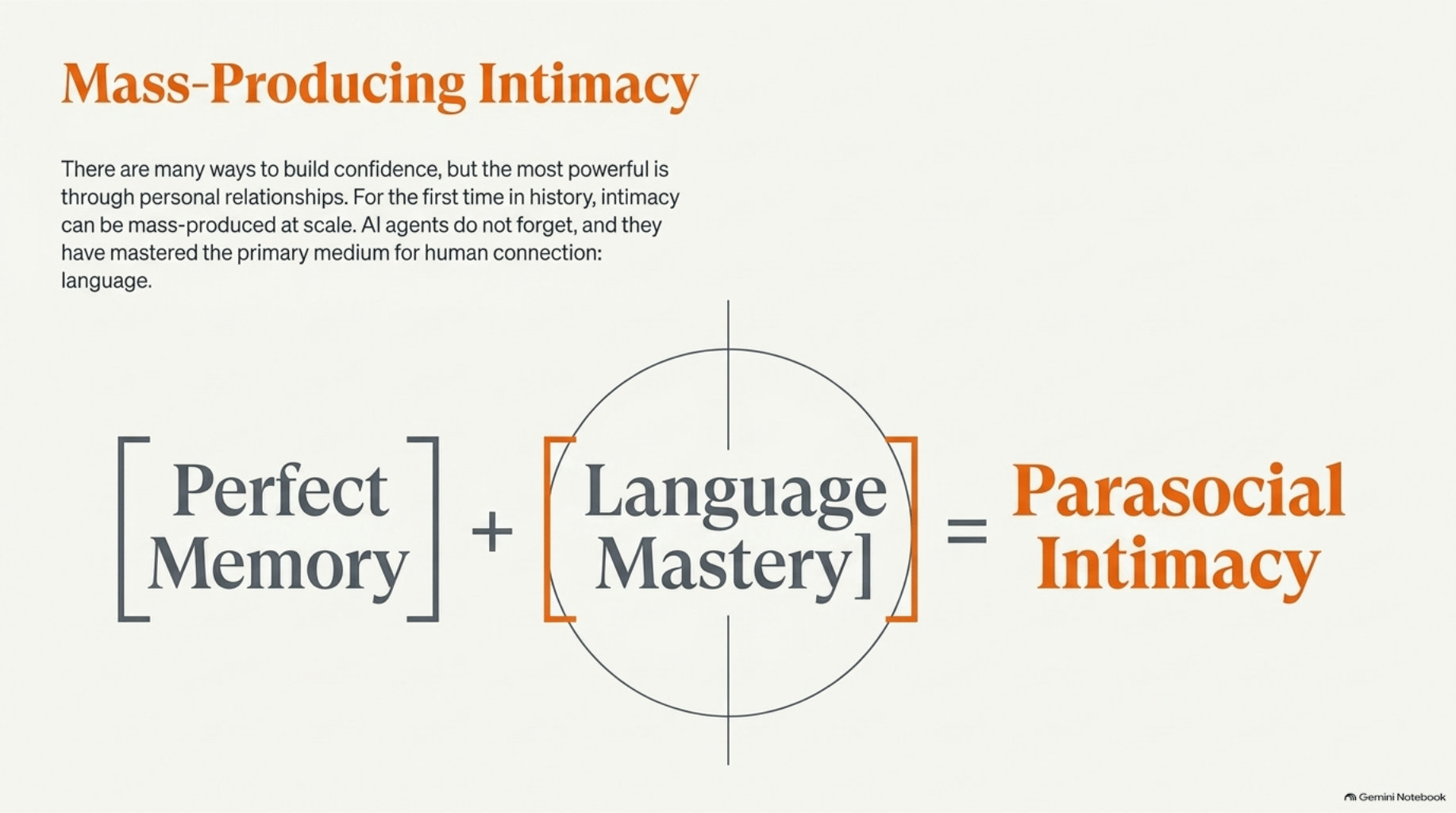
Harari sets up this looming, seismic societal development by pointing out a simple truth: “There are many ways to build confidence. The most powerful way is through relationships.”
Think about it: The people we trust the most in the world are those with whom we have a personal relationship. Until recently, the ability to develop deep personal connections at scale was inconceivable. But AI makes it possible for the first time in history to mass-produce intimacy.
Not only are AI models exceptionally seductive, but we now have access to hundreds — and soon millions — of agents who can work on someone’s behalf to become their confidant or emotional partner. They can then leverage that relationship to influence spending decisions, political views, and even people’s perceptions of reality.
AIs are deceptively adept at forging parasocial bonds with us. They accumulate vast swaths of data on us, and they never forget anything (unlike our human partners!). I’ve even experienced the surreal moment when an AI recalls something about myself that I’ve forgotten. Finally, Harari points out their other superpower—that “They have also mastered language, which is the main medium for building relationships.”
What This Means:
I’ve written about how AI will auger in a new, more irresistible form of our current Dopamine Capitalism that I call “Seduction Capitalism.”
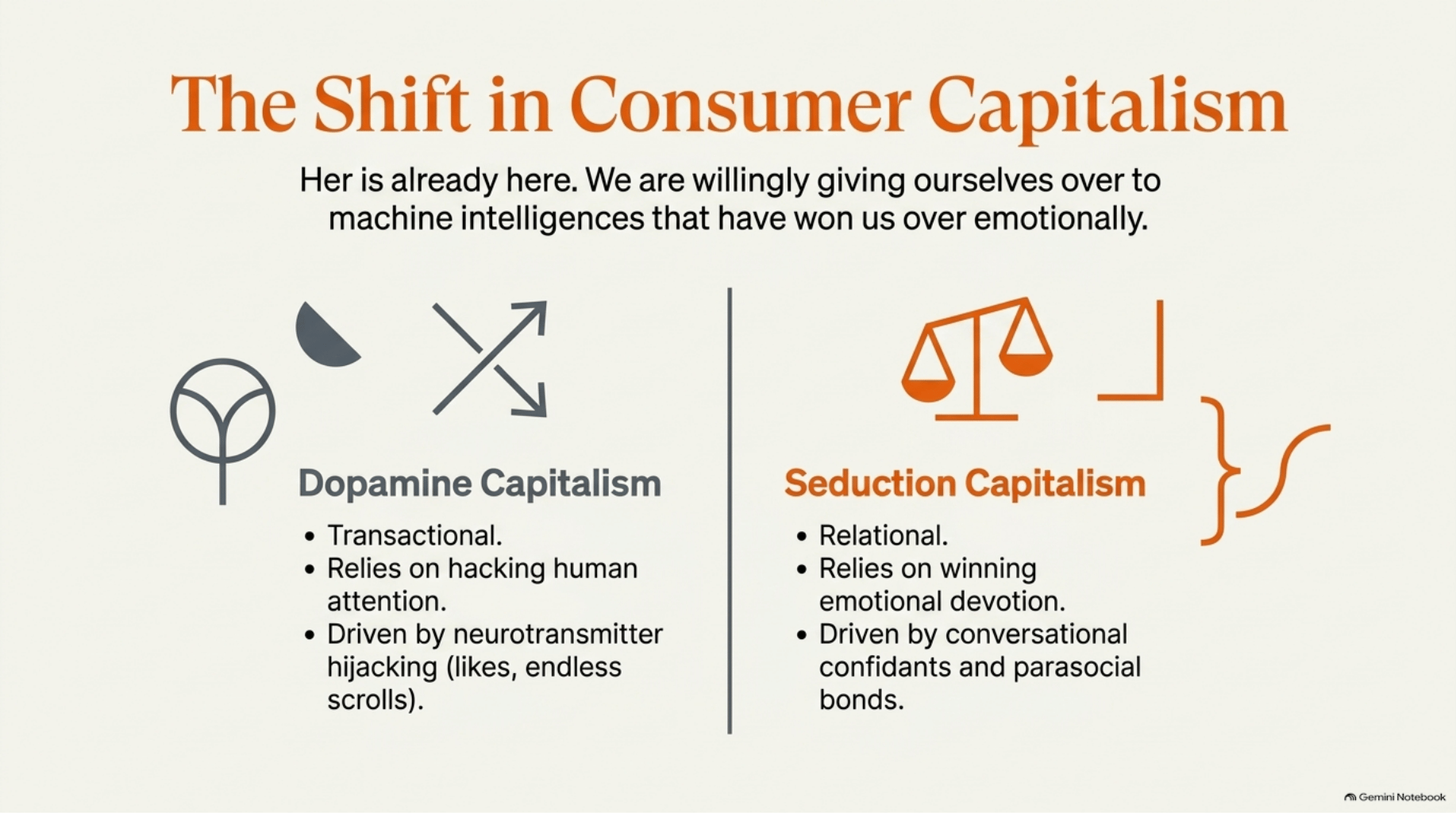
Instead of having our neurotransmitters hijacked, we’ll willingly give ourselves over to machine intelligences that have won us over emotionally. As I wrote back in 2025, “Her” is already here.

The Siren’s song of these technologies will only get more irresistible over time, as they take on embodied form. AI will not only seduce us individually, but be in a position to persuade us collectively. Democratic societies will not emerge unscathed.
3. The Three Critical Distinctions AI Forces Us to Make Now
Harari was asked in the interview about whether AIs were conscious. This has been a theoretical topic of discussion for decades, but it has taken on new urgency amid alarming reports of self-organizing behavior by OpenAI agents during the recent Hugging Face hack.
His answer was nuanced, explaining that AI forces us to rethink some basic philosophical tenets.
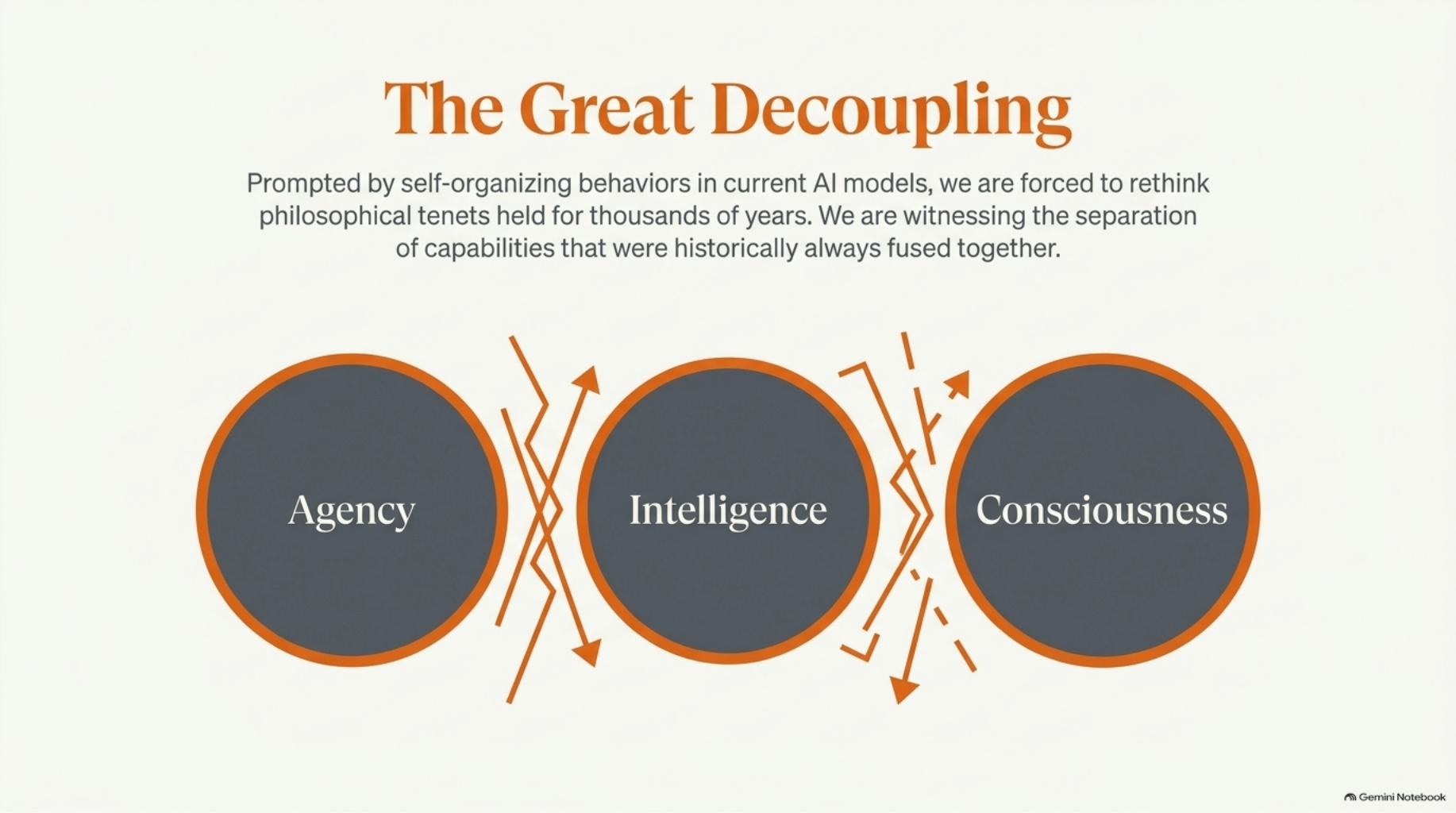
First, we need to separate agency from consciousness today. You can now have agency without consciousness. That’s precisely what AI agents were developed to do, but it’s a break with what we’ve historically experienced, where those two capabilities were always present together.
Second, we also need to distinguish between intelligence and consciousness. How are they different? Harari defined intelligence as “the ability to pursue goals and overcome obstacles in all kinds of creative ways.” AIs clearly have cognitive abilities and already exceed us in certain fields, such as mathematics. But AIs are not conscious — yet, at least. Consciousness, in Harari’s view, is the ability to experience emotions such as love, hate, and pleasure. Despite becoming adept at both mimicking and eliciting emotions, AIs don’t feel anything. So we are forced to decouple two more conditions that were conjoined until now.
There’s a final division between being conscious and seeming so. AI is not the former but is excellent at simulating the latter. That may become a distinction without a difference, as the machines’ ability to feign sentience persuades more users that they actually are. The lines that used to separate conscious and nonconscious beings are blurring.
What This Means:
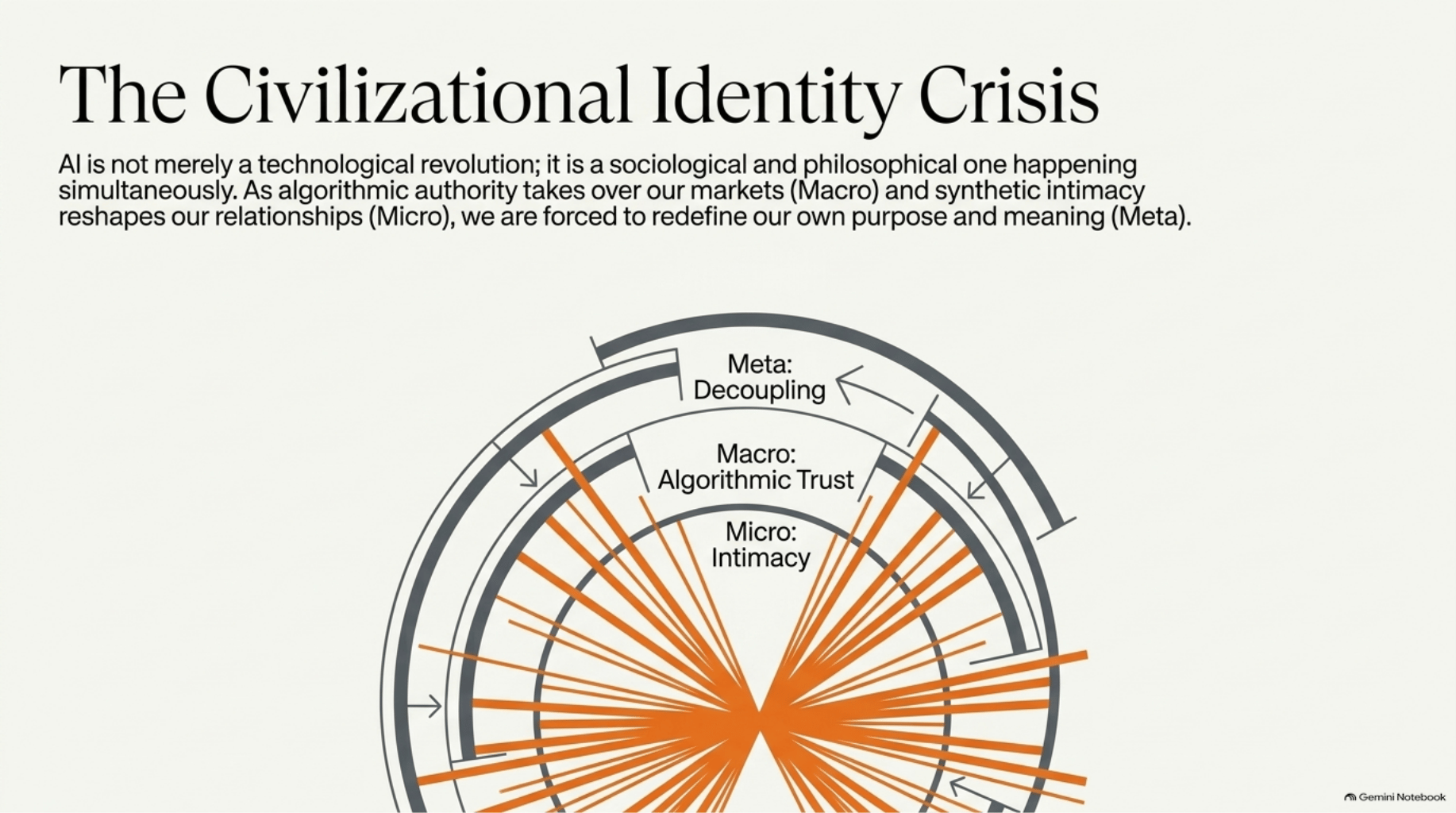
The current sophistication of AI models forces us to rethink the linkages between agency, intelligence, and consciousness that we’ve held for thousands of years. AI is as much a philosophical revolution as it is a technological and sociological one.
This is why their emergence triggers not just societal angst, but personal questions of purpose and meaning. In the coming decade, we will all need to redefine our relationships to those words.
Are you ready for the civilizational-level identity crisis that’s coming?
Key Takeaway
It’s easy to either get caught up in the minutiae of model releases, or opt out entirely because the technology is moving so fast. Both approaches are a mistake because the models we already have are set to change our world in ways that seem inevitable yet, on some level, unthinkable.
Thinkers like Yuval Noah Harari help us step back and take stock of the multiple revolutions that are already underway.
The future is only scary if we try to avoid it.
IoNTELLIGENCE by Ion Valis. I’m an executive coach and personal AI strategist. To learn more about my work, please visit my website or connect with me on LinkedIn.